3D game October 2026 — present
AtomTaxi
Taxi simulator in Tashkent
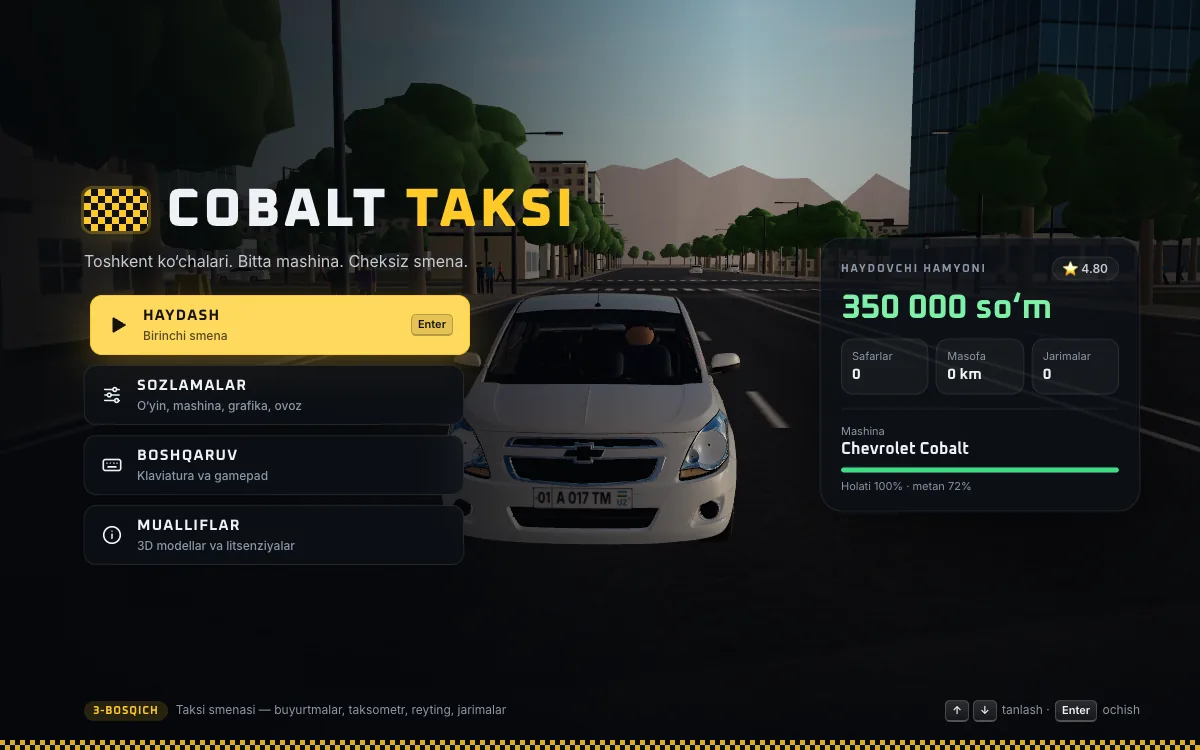
Drive a Chevrolet Cobalt taxi through a Tashkent-style city: take orders, follow GPS, run a real taximeter, buy methane, collect fines and rating. In the browser, for desktop.
- 2
- drivable cars
- 5
- city districts
- 7.5 → 1.2M
- triangles per frame
- 30
- commits
Problem
Browser driving games are usually arcade: the car sticks to the road, the city is empty, there is no economy. The goal was a simulator that feels like a taxi driver's shift in Tashkent — real physics, living traffic and real fares, with nothing to install.
Solution
- Rapier raycast vehicle: suspension, weight transfer, handbrake drift and turbo; a custom rear-wheel-drive model for the Mercedes (burnout, donut, figure eight)
- A living city: AI traffic on the IDM model, two-phase traffic lights, pedestrians on zebra crossings, junction reservation
- A taxi shift: orders in a phone app, A* GPS over the lane graph, a taximeter on the Yandex Go tariff, methane, fines and rating
- Sound is synthesised without files: engine in an AudioWorklet, turbo whistle, tyre squeal; the Mercedes uses real V8 recordings
Architecture
- Physics on a fixed 1/60 s step with visual interpolation; 0–100, braking distance and drift symmetry are measured by browser tests
- The static city is merged into one mesh per material, crowds use InstancedMesh, trees have 3 LOD levels
- If FPS drops below 40 the graphics step down on their own; a preset is chosen from the GPU and core count
- three and rapier live in separate chunks, so a game update reuses the cached libraries
- Progress, damage and settings in localStorage; a render-free simulation in dev mode for automated tests
// Contact
Have a project?
Let's build it.
A new product, rewriting an existing system or a collaboration — message me on Telegram, I usually reply within a day.
Telegram: @atomlabs_support